This is the year to approach it with clarity and precision. The global mobile ecosystem continues to expand at an unprecedented pace, with the mobile application market projected to exceed $626 billion by 2030 and global consumer spending on apps and in-app services expected to surpass $230 billion by 2026. In this landscape, mobile apps are not just tools, they are strategic revenue drivers, customer touchpoints, and brand differentiators.
As the mobile app market grows, apps are not simply a means of attracting and retaining consumers; they also drive revenue, foster consumer engagement, and differentiate a brand from the competition. In summary, mobile apps are a business strategy and should be developed and approached accordingly. That strategy is called a mobile app technology stack.
When selecting a mobile app technology stack, it is important to choose a programming language or framework that is most appropriate for the app and the company developing it. In addition, it is important to establish a foundation for the app’s performance, scalability, security, maintainability, and long-term sustainability. Choosing the right technology stack for an app will help ensure it functions optimally, scales with user growth, integrates with the latest technologies, and meets ever-changing market needs.
However, poor technology stack choices will cause deficits in app performance, a decline in user experience, increased and unnecessary technical debt, and refactoring will be more costly and burdensome. In this guide, we will define a mobile tech stack, discuss its importance, and explain how to identify the best mobile tech stacks for your business, its growth, and the market.
Key Takeaways
- With the global mobile application market projected to reach over $600 billion by 2030, mobile application development platforms (MDPs) are more essential than ever, as mobile consumer spending is expected to exceed $230 billion by 2026.
- The selection of the mobile app technology stack is a development decision that will have immediate and long-term effects on performance, security, sustainability, and the efficiency of mobile app maintenance.
- Your chosen mobile application development platform (MDP) will influence the application’s speed, cross-platform operability, time-to-market, development cost, and useful life.
- When employing a mobile application development platform (MDP) market, it is critical to incorporate front-end frameworks, back-end technologies, databases, application programming interfaces (APIs), and cloud computing.
- Given the rapid pace of technological change, the mobile app technology stack must include front-end and back-end integration and an API-based cloud computing framework to ensure efficiency and seamless integration.
- The business goals, target audience, scalability needs, budget, compliance requirements, and the team’s expertise are the key decision drivers.
- To meet your performance and growth objectives, each app type (native, cross-platform, hybrid, PWA, on-demand, etc.) requires a different combination of technologies.
- Popular 2026 tech stacks include:
– iOS: Swift, SwiftUI, Node.js, Firebase, PostgreSQL
– Android: Kotlin, Jetpack Compose, Node.js, Firebase
– Cross-Platform: Flutter, React Native, Firebase, .NET Core
- What do successful companies such as Uber, Instagram, Airbnb, and Spotify have in common? They all have the right tech stack for their product goals, expected growth, and customer needs. They do not follow mobile app development trends.
- A strategy-first, structured approach provides the most value by ensuring your tech stack covers growth, security, performance, app store optimization, and support for future scaling without expensive rework.
- In 2026 and beyond, determining your app’s competitive advantage starts with selecting the right mobile app tech stack. This task goes beyond technology and is critical for your business.
Market Statistics for Mobile App Technology Stack
- Global Market Size: By 2026, the global mobile applications market will reach $357.6 billion, up from $313.9 billion in 2025, reflecting annual growth in digital app usage.
- Market Expansion Forecast: The global mobile application market will exceed $1 trillion by 2034, from $330 billion in 2026.
- App Development Segment Growth: The mobile applications market will reach $391.3 billion by 2026 and $864.5 billion by 2031, showing a need for application development, deployment, and continuous improvement.
- Platform & Tools Market: The continued evolution of cloud technologies and low-code platforms will drive the Mobile Application Development Platforms (MDP) Market to over $375.2 billion by 2026 and to nearly $1.11 trillion by 2034.
What Is a Mobile App Technology Stack?
A mobile application technology stack consists of the programming languages, frameworks, and other tools and technologies used to develop a mobile application. It serves as the engine of the application, determining its visual representation and how it functions. Regard it as the foundation framework of your mobile application. Just as a building requires a firm foundation, your application needs a strong, reliable mobile tech stack to maintain its speed, security, and growth.
A complete mobile app tech stack includes:
- Frontend Development Tools: Swift for iOS applications, Kotlin for Android applications, and Flutter for Cross-platform applications.
- Backend Development Technologies: Node.js, Django, and Firebase.
- Databases: PostgreSQL, MongoDB, and MySQL.
- Development Platforms & APIs: AWS, Google APIs, and Payment Gateways.
In this form, we do understand how important selecting an appropriate mobile app tech stack is, so understand how it is prepared and why it is important for an application to be responsive and formable.
Why Choosing the Right Tech Stack Matters?
Your app technology stack is much more than an arrangement of tools, it serves as the ‘core’ of the app for its entire lifecycle. The success or failure of a mobile application is directly proportional to the technology stack, from development through deployment to performance and scalability. Any mobile application tech stack that is incorrectly chosen can cause slow speeds, compatibility issues with other systems, security risks, and increased costs, ultimately leading to significant app development challenges that can impact long-term growth and operational efficiency.
Here is why an appropriate mobile app tech stack is so highly valued.
- Impacts App Speed and Performance: In a technology stack, performance optimization and speed are critical.
- Determines Cross-Platform Compatibility: With the appropriate technologies, you have the capability to do app deployments and development for both iOS and Android.
- Affects Scalability and Maintenance: The mobile technical stack remains relevant to the user base and streamlines update delivery.
- Influences Time-To-Market: The best stack for mobile apps enables a faster app development cycle, helping you stay ahead of competitors.
- Directly Impacts Development Costs: The right tools and frameworks can help you avoid rework, launch delays, and unplanned expenses.
Whether you are creating a native Android or iOS tech stack, or planning to pursue cross-platform app development, the app tech stack should align with your goals, audience, vision, and budget. In the rapidly phasing mobile app world, selecting the right technology stack is the first step in the mobile app development process to ensure a high-performance, scalable, and cost-effective mobile application.
Factors to Consider When Choosing a Mobile App Tech Stack
Identifying a mobile app tech stack is not only about app suitability but also about the critical determinants of the mobile app’s business strategy and business case for development.
Consider these points before finalizing the mobile app tech stack.
- Business Objectives: Consider app complexity, key mobile app features, performance, and if real-time updates, such as a chat feature or live tracking, are necessary.
- Choice of Platform: Consider if you need a native app (Android or iOS) or a cross-platform mobile app.
- Costs: Avoid exceeding the development and long-term app maintenance costs.
- Privacy: Choose a tech stack with rigorous protocols to ensure compliance, encryption, and protection of sensitive data.
- Scalability: Selecting the appropriate mobile tech stack for your business applications supports the growth of your application, accommodates a large user base, and the evolution of new functionalities.
- Team Expertise: Make sure your app tech stack is aligned with the mobile app developers’ skill set to enhance the developer’s capability, improve productivity, and reduce the learning curve.
The right mobile technology stack fosters seamless development while enhancing operational efficiency.
Types of Mobile Applications
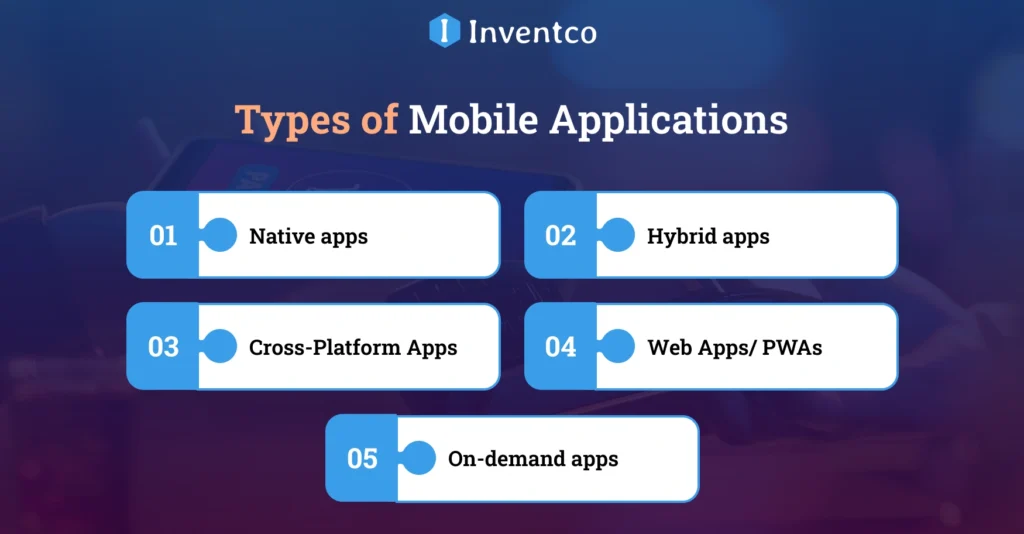
One of the most important things before you choose the best mobile app tech stack is to understand the types of apps you are building. The mobile applications below take different approaches to technology requirements and the development process.
- Native apps are designed to run on a single platform, using Swift for iOS app development or Kotlin for Android app development, to achieve superior performance and seamless mobile app integration.
- Hybrid apps combine features of native and web applications, using development platforms such as Ionic or Apache Cordova. Although more readily available, this class of mobile applications suffers a significant loss of functionality.
- Cross-Platform Apps are contemporary mobile applications that run on multiple platforms as a single application. It leverages a unified codebase to enhance development speed and performance using tools such as Flutter or React Native.
- Web Apps/ PWAs are a class of mobile applications that are accessible through a web browser. This class of applications is handy for users who wish to access mobile applications without the hassle of downloading from the app store.
- On-demand apps are mobile applications that provide real-time functionality and cloud integration. This class of applications also requires a robust cloud system for unhindered scalability.
For example, the technology stack of an on-demand app should include seamless UI/UX, real-time databases, cloud storage, and a powerful backend.
How to Choose the Best Tech Stack for Your Mobile App?
Selecting the right technology stack for your app is a strategic decision that directly affects your app’s scalability, performance, and success.
Below is the step-by-step checklist to guide you:
- Define Your App’s Purpose and Target Users: Define what your application intends to achieve and who the potential users are. This is one of the most important aspects to consider while selecting an app tech stack. This tool helps your application achieve its core features and improves the overall user experience.
- Pick the Correct App Type: The next step on the checklist is choosing the correct type of application. Based on the performance, goals, budget, and the users, you can select a native, mixed, cross-platform, PWA, or other application types.
- Set a budget and a schedule: Again, carry out budget estimates and set date/deadline expectations on when the mobile app can be ready for release, as it is one of the most important aspects of app development.
- List Essential Features & Third-Party Integrations: Identify key components such as instantaneous updates, payment systems, payment portals, and payment notification systems.
- Plan for Future Scalability: Ensure the app’s tech stack allows for necessary growth, additional users, and regular updates.
This set of tasks helps you strategically select a tech stack that will deliver value for many years.
Mobile App Development Tech Stacks by Platform
For mobile applications, you would want to decide on a tech stack for each, native iOS and Android, as well as for cross-platform applications.
Let’s examine the recommended tech stacks in correlation to the targeted platform of your app:
Best Tech Stack for iOS App Development (2026)
For iOS app development, the chosen tech stack must prioritize privacy and app security, performance, and deep integration with the Apple ecosystem. iOS device users appreciate a polished user interface and quick, seamless performance, and your iPhone app development tech stack can help you deliver that.
Below is the suggested iOS tech stack for making a current, high-performing app for iOS in 2026:
Frontend:
- Swift: It is Apple’s official programming language for iOS app development. Swift is known for its speed, safety, and easy-to-read syntax that makes it ideal for building high-performance and reliable native iOS apps.
- SwiftUI: It is a powerful UI framework by Apple that allows iOS app developers to create responsive, visually stunning, and declarative user interfaces for iOS apps with less code. It’s designed to work seamlessly with “Swift” and speed up the app development process.
Backend:
- Node.js: It is a lightweight, high-performance runtime environment for this iOS app, which is ideal for creating scalable, real-time applications like chat, live tracking, and streaming platforms. It’s perfect for handling multiple simultaneous requests efficiently.
- Django: Django is one of the safest and highest-level Python frameworks built for fast server development. It’s especially suited for database-driven apps, which offer built-in features that boost your mobile app’s speed, scalability, and security.
- Firebase: It is a leading Backend-as-a-Service (BaaS) platform by Google. Firebase offers a real-time database, authentication services, seamless cloud integration, and is easily scalable, which makes it a favorite for startups and fast app development.
Database:
- Realm: It is a lightweight database and offers an offline-first mobile database.
- Core Data: It is a particular design for the iOS platform, and it is an Apple framework for data persistence.
- PostgreSQL: It is one of the renowned databases, which is a reliable and robust relational database.
Tools:
- Xcode: It is the official Integrated Development Environment for iOS app development.
- TestFlight: This tool is best for beta app testing and user feedback before you full-launch your mobile app.
This mobile tech stack delivers a smooth, reliable, and powerful native iOS experience, which is easily scalable in the tech world.
Best Tech Stack for Android App Development (2026)
When you develop an Android app in 2026, you need to choose a tech stack that delivers flexibility, modern UI/UX, and smooth app performance. As we discuss Android, it powers a wide range of devices, so you need to ensure your tech stack supports a range of screen sizes, user needs, and hardware capabilities.
Here are some recommendations for the Android app tech stack for 2026:
Frontend:
- Kotlin: It is one of the most famous and Google’s preferred language for Android apps. It is secure, concise, and fully interoperable with Java.
- Jetpack Compose: It is one of the modern toolkits for Android apps. It is for creating native UI with less code and powerful features.
Backend:
- Node.js: It is one of the best backend runtime environments that allows JavaScript to run smoothly. People choose this for scalable and event-driven backends.
- Firebase: It is beneficial for real-time apps and rapid development with built-in tools.
- Spring Boot: Enterprise-grade backend solution with robust support for microservices.
Database:
- SQLite: SQLite is a basic and lightweight database that stores data directly on your smartphone. It also works without the internet, as it is fast and reliable for local storage.
- Room: It is the toolkit that makes it easier to use SQLite. It offers you better architecture and security. We can also say it’s a smarter way to manage your app data when you are using SQLite.
- Firebase Realtime Database: This is the cloud database that keeps your app data updates in real-time. If something changes in your database, it shows in real time to all the users.
Tools:
- Android Studio: It is the official software by Google where Android developers write and create Android apps.
- Gradle: It is the tool that helps you automate the development of your native app. This tool is very useful for you as it handles compiling the code and manages all the extra parts your app needs; it makes the whole app development process faster and smoother.
This mobile tech stack for Android apps is ideal for creating high-performance Android apps in 2026.
Best Tech Stack for Cross-Platform App Development (2026)
One of the most trending app development platforms is cross-platform, where you can build an app once and launch it everywhere. The aim is to create a mobile app that works smoothly on both platforms, iOS and Android, and saves your time and budget without sacrificing performance or user experience.
Here is the top tech stack for cross-platform app development in 2026:
Frameworks:
- Flutter: It is one of the most famous frameworks backed by Google. It helps you to create a powerful UI for creating natively compiled apps from a single codebase with fast interfaces.
- React Native: This framework is developed by Meta, previously known as Facebook. It helps to build a mobile app using JavaScript and React, with near native performance.
Backend:
- Firebase: It offers real-time databases, provides authentication, and offers cloud functions. It is one of the best comprehensive Backend-as-a-Service (BaaS).
- Node.js: One of the most trending, flexible, scalable backend technologies in the world, that is perfect for handling APIs and real-time communications.
- .NET Core: It is a cross-platform backend framework for building robust and secure services for your mobile app.
Database:
- Firebase Realtime Database: The Firebase Realtime Database updates info quickly across all users. This database is great for apps that offer live chat or live updates. With the help of FRD, everyone can see changes in real-time without needing to update the screen.
- MongoDB: It is a NoSQL database, which means it is a super-flexible database. With the help of MongoDB, you dont need to stick with a strict structure. It is best for those apps with changing or complex data.
- SQLite: It is a small database that stores data directly on the device, making it very easy to use. A SQLite database is ideal for offline uses like notes, saving settings, or anything local.
Tools:
- Visual Studio Code: One of the most loved code editors loved by mobile app developers, due to its lightweight and flexibility. VS Code is fast and easy to use. It supports tons of plugins to make coding smoother and smarter.
- Expo: It is a handy toolset for React Native apps. With the help of Expo, you can create, test, and preview your app quickly, without needing all the heavy setup. It is ideal for fast mobile app development.
This tech stack is perfect for startups and SMEs seeking speed, broad reach, and cost-effectiveness in their app development journey.
Examples of Popular Tech Stack Combinations
When it comes to mobile app development, some of the biggest names have nailed their tech stacks to fit their unique requirements perfectly.
Let’s look at some battle-tested technology stack combos that power the apps millions love:
- Uber (On-Demand App): Uber’s tech stack includes Swift for the iOS frontend, Node.js for server services, and PostgreSQL for a stable, scalable database. This mix helps Uber’s real-time tracking, complicated operations, and huge user base.
- Instagram: Famous social media app Instagram uses React Native for its cross-platform frontend, Python/Django as a powerful server system, and PostgreSQL to handle vast amounts of data effectively. This tech stack allows quick feature rollouts with smooth performance.
- Airbnb: Airbnb’s stack includes React Native for UI, Ruby on Rails for core logic, and MySQL for a tabular data store. This setup combines fast development with scalability and stability.
- Spotify: Spotify focuses on Java for core app development, Python for data processing, and Google Cloud for scalable cloud infrastructure, handling millions of streams daily with ease.
Each of these giants chooses a best tech stack that perfectly matches their app’s goals, user demands, and growth strategies, proving there’s no one-size-fits-all answer, just the right tools for the right job.
Cost of Developing a Mobile App Based on Tech Stack
The cost of mobile app development varies depending on the chosen Tech Stack. Every technology has its own unique characteristics and requires different skills, tools, and time, which affect the overall cost of your mobile app development.
Here are some rough ideas for the cost breakdown as per the Tech Stack:
- Native Apps (iOS or Android): If you choose a native app, costs can range from $30,000 to $100,000+ due to platform-specific development and the complexity of the OS.
- Cross-Platform Apps: It is one of the most cost-effective ways to create your app for different platforms using the same code. It generally ranges between $20,000 and $80,000.
- On-Demand Apps: it is one of the most common in comparison to pricing and range between $50,000 to $150,000+, just because of the advanced and real-time feature to meet your demand.
There are many factors that influence the cost of app development, including the complexity of your chosen tech stack, your mobile app developers’ experience, and the location of the dedicated developers. The third-party tool and API integrations also affect the cost of developing an app. Choosing the right mobile app tech stack is essential to ensure your app is robust and scalable while keeping mobile app development costs down.
How Can Inventco Help You Build a Scalable App?
Here at Inventco, we pride ourselves on our cutting-edge technology, and an emphasis on technical accuracy as well as measurable business success on each project. This means we take time to understand your business needs as well as your aims for future growth and roadmap so that we can advise on the best technology along with the optimal growth strategy you have in mind. We also take the time to understand your business’s compliance needs and requirements.
Our mobile app developers use the best technologies to optimize app performance, enhance security, and future-proof our approach so the app remains scalable without accruing technical debt. We also consider the above-mentioned factors and use the best technology to ensure the app continues to accrue technical debt.
We also take time to ensure that our interventions for your scalable app development work, and we document our processes. We also deliver our work to the highest standards as we develop a secure app with an efficient architecture and analytics built in, so your business can continue to grow. This is also to ensure that the growth is data driven analytics.
We build your idea into a scalable field mobile app, ready to launch in the marketplace and give you a competitive edge. Your app is built with future growth and sustainability in mind also along with the first development model and guidance, so that there are no gaps in the technology or missed goals in the overall quality.
Conclusion
The mobile app technology stack is the most critical choice you’ll make for your app’s success in 2026. Your app can win the competition, scale quickly, and wow consumers if you use the right tools, frameworks, and programming languages. Whether you’re searching for the greatest tech stack to construct an app, analyzing a technology stack for iOS app development, or picking the most efficient Android app technology stack, make sure your decision aligns with your company’s objectives and technical demands.
FAQ
Q1. What is a mobile app technology stack?
Ans. A mobile app technology stack is the set of tools, programming languages, and frameworks used to build an app. It includes both frontend (what users see) and backend (server-side).
Q2. Why is choosing the right tech stack important?
Ans. The right tech stack helps your app run smoothly, load faster, scale easily, and stay secure. It also affects your app’s development time and cost.
Q3. What is the best tech stack to create an app in 2025?
Ans. It depends on your goals. Use Flutter + Firebase for cross-platform, Swift + Node.js for iOS, and Kotlin + Spring Boot for Android.
Q4. What’s the difference between native and cross-platform tech stacks?
Ans. Native stacks are platform-specific (iOS or Android), while cross-platform stacks use one codebase for both platforms.
Q5. How does the tech stack affect app cost?
Ans. Complex tech stacks or advanced features need more development effort, which can increase both initial cost and long-term maintenance.
Q6. Can I change my tech stack later?
Ans. Yes, you can, but it’s usually time-consuming and expensive. It’s always better to choose the right stack from the beginning.
Q7. What is the best tech stack for mobile app development for startups?
Ans. Startups often choose Flutter + Firebase because it’s fast to develop, cost-effective, and works for both iOS and Android.
Q8. What is the ideal technology stack for Android apps in 2025?
Ans. For Android, Kotlin + Firebase + Room Database is a strong and reliable tech stack used by many developers.
Q9. Which stack is best for iOS app development?
Ans. For iOS apps, Swift + SwiftUI for frontend and Node.js for backend is a great stack in 2025. It’s fast, modern, and secure.
Q10. How much does it cost to develop a mobile app?
Ans. Mobile app development can cost anywhere from $20,000 to $150,000 or more, depending on app type, platform, features, and tech stack.

Sandeep Agrawal
Sandeep Agrawal is the visionary CTO at InventCoLabs, bringing innovation to life through his technical expertise. With a passion for cutting-edge technologies, Sandeep leads the team in developing robust solutions. His dedication and continous efforts to pushing the boundaries of what’s possible defines his role as a transformative and innovative force in the tech industry.